



Eladi Thailam: The Classical Ayurvedic Face Oil and How to Use It
If you have read about Pitta skin, or facial Abhyanga, or classical Ayurvedic face care anywhere in this site, you have encountered the name Eladi Thailam. It is referenced consistently — and deliberately. It is not a recent formulation or a marketing construct. It is one of the most precisely documented classical Ayurvedic face oils, with a formulation that appears in the Sahasrayogam — a classical Kerala Ayurvedic text — and a history of use in traditional practice spanning centuries.
This guide covers everything you need to understand Eladi Thailam: where it comes from, what its key ingredients are and what classical Ayurveda describes as their properties, which constitution and skin state it suits, and exactly how to use it.
The Classical Source: Sahasrayogam
The Sahasrayogam (literally "a thousand preparations") is a classical Ayurvedic text from the Kerala tradition, compiled from older sources and focused primarily on practical clinical formulations. It is one of the primary reference texts for the Kerala Ayurvedic school — the tradition that produced many of the most refined classical Ayurvedic therapeutic oils and treatments still in use today.
The Eladi Tailam formulation in the Sahasrayogam appears in the context of preparations for the face and skin — specifically for conditions described in classical terms as involving excess Pitta in the skin (Bhrajaka Pitta), heat at the surface tissues, discolouration and sensitivity. The formula's consistent appearance in this context across subsequent classical and semi-classical texts confirms its primary classical indication: the warm, sensitive, reactive skin state associated with Pitta.
The name Eladi comes from its lead ingredient: Ela — cardamom (Elettaria cardamomum). In classical Ayurvedic pharmacology, the naming convention for compound formulas often references the primary or first-listed herb. Eladi Tailam is "the oil of cardamom and its companions."
The Key Ingredients and Their Classical Properties
Ela — Cardamom (Elettaria cardamomum)
The lead herb. In classical Ayurvedic pharmacology, cardamom is described as having a sweet and pungent taste (Rasa), cooling energy (Virya, despite the pungent component — the sweet taste dominates), and a lightening, clarifying quality. It is classically described as tridoshic in balanced use — balancing to all three Doshas — with particular benefit to Kapha and Pitta through its aromatic, clearing qualities.
In external preparations for the face, cardamom's cooling and clarifying properties make it appropriate for Pitta-associated skin states.
Ushira — Vetiver (Chrysopogon zizanioides)
One of the classical Ayurvedic cooling herbs. Ushira's root is used — fragrant, cooling, and described in classical texts as specifically Pittahara (Pitta-pacifying). It is among the herbs most consistently referenced in classical formulas for skin conditions involving excess heat, and its cooling property is considered particularly direct.
In Eladi Tailam, Ushira provides the primary cooling action — directly addressing Bhrajaka Pitta and the heat and sensitivity it produces when elevated.
Chandana — Sandalwood (Santalum album)
Sandalwood is among the most referenced cooling herbs in classical Ayurvedic dermatological formulas. Classically described as having a bitter and sweet taste, cooling energy, and a heavy, oily quality — properties that cool, soothe and nourish simultaneously. The classical Sanskrit texts describe Chandana as Pittakapha nashak (reducing Pitta and Kapha accumulation) and Tvak prasadana (clarifying and brightening to the skin).
In external preparations, sandalwood's combination of cooling and nourishing properties — unusual among cooling herbs, which tend to be drying — makes it particularly suited to Pitta skin care, where cooling is needed without adding dryness.
Priyangu — Callicarpa macrophylla
A classical Ayurvedic herb less well-known outside traditional practice. Priyangu is described in classical texts as cooling, astringent and Pittahara. In skin formulations, its astringent quality adds a refining and toning dimension to the cooling action of the other herbs.
Musta — Cyperus rotundus (Nut grass)
Musta is classically described as bitter, pungent and astringent in taste, with cooling energy. It is referenced in classical Ayurvedic texts for a wide range of indications — notably for conditions involving Pitta and Kapha, excess heat, and skin-related Pitta accumulation. In skin formulations, its bitter and cooling properties complement the cooling herbs.
The Base Oil — Coconut (Narikela Taila)
The choice of coconut oil as the base for Eladi Tailam is not incidental. Coconut oil is classically described as cooling — unusual among oils, most of which are warming. This cooling base is precisely appropriate for a formula intended for Pitta and heat-associated skin conditions. It is also light enough to suit the more delicate facial skin tissue without the heaviness of sesame.
The combination of cooling base oil with cooling, astringent and nourishing herbs produces a formula that is cooling throughout — from base to botanicals.
Who Is Eladi Thailam For?
The classical indication is clear: warm, sensitive, reactive skin in a Pitta-dominant or Pitta-elevated state. In practice, this translates to:
Pitta skin type: The primary match. Warm, sensitive, reactive — flushes with heat, spicy food, stress and alcohol. Prone to redness and sensitivity. Needs cooling without drying.
Vata-Pitta dual constitution: The most common dual type in contemporary European populations. Dry from Vata, sensitive from Pitta. Eladi Tailam's cooling coconut base and its botanical nourishment address both simultaneously — cooling the Pitta sensitivity while providing enough nourishment for Vata's dryness. It is one of very few classical face oils that genuinely suits this common combination.
Pitta-elevated skin regardless of base constitution: In summer, after extended heat exposure, during high-stress periods — any constitution can experience Pitta elevation in the skin. Eladi Tailam is appropriate in these periods even for primarily Vata or Kapha types.
Sensitive, reactive skin as a presenting condition: Many people do not know their Dosha but know that their skin reacts — to heat, to products, to seasonal changes. This presentation maps closely to Bhrajaka Pitta elevation and is precisely what Eladi Tailam addresses.
Not the primary choice for: Pure, cold-type Vata skin in winter without reactive tendencies (which needs more warmth and weight); Kapha-dominant skin that is oily and congested (which needs stimulating and lighter formulas).
Not sure of your skin-Dosha? Read the guide to Ayurvedic skin types by Dosha or take the free Dosha test.
How to Use Eladi Thailam
As a Daily Facial Oil
Amount: 3 to 5 drops per application. Eladi Tailam is a face-specific oil — a small amount is appropriate.
Method: Place drops in the cupped palm. Rub both palms together for 15 to 20 seconds until the oil reaches skin temperature. Apply to clean, dry skin with upward outward strokes — not patted on, but worked in with deliberate contact.
Timing: Morning, after cleansing. Evening application before sleep is also appropriate — the overnight absorption period is particularly valuable for Pitta skin.
With Mukha Abhyanga: Eladi Tailam is the oil for a complete facial Abhyanga practice — applied with the full stroke sequence including jaw, temples, orbital area and Sthapani marma. Complete technique guide here.
With the Kansa Wand
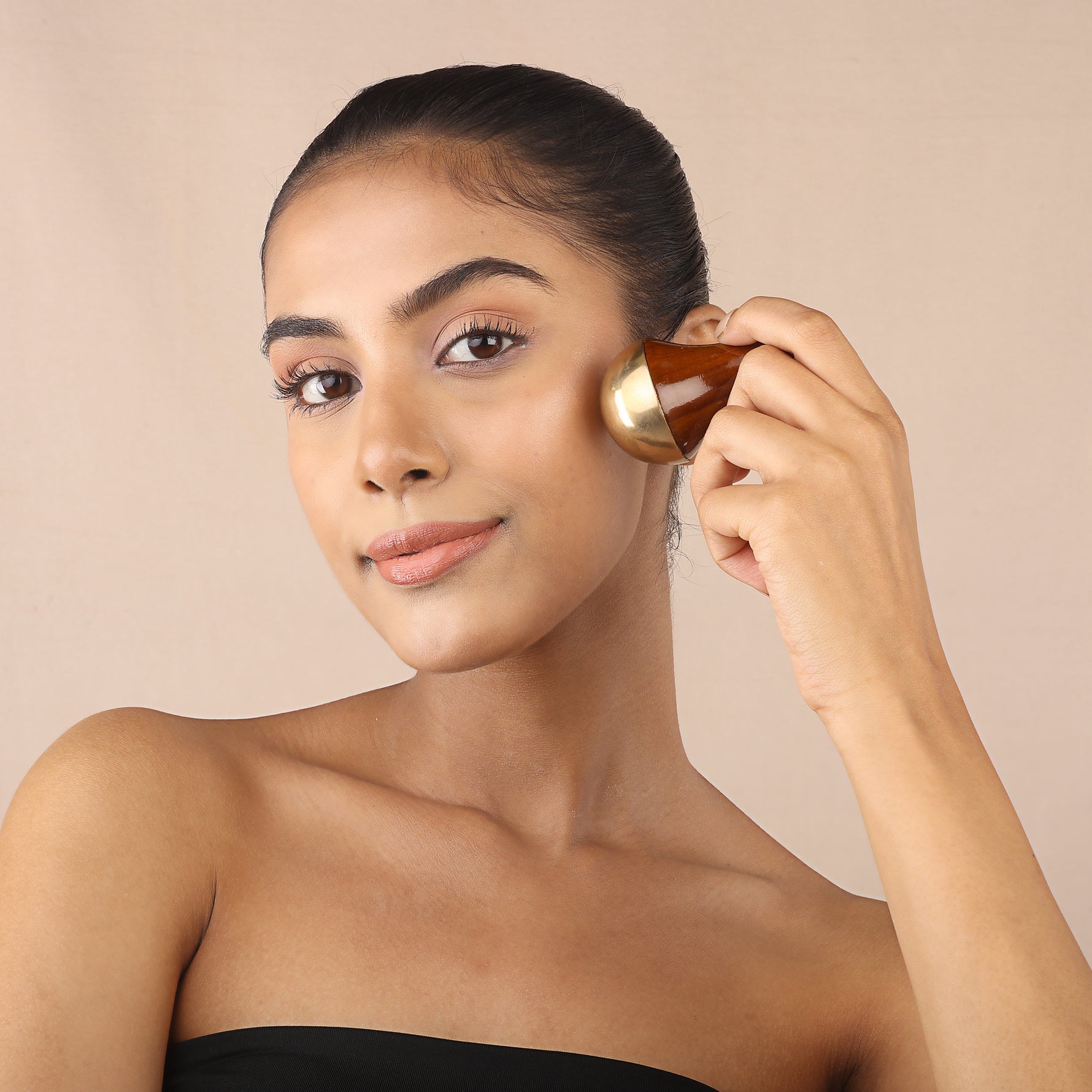
Eladi Tailam is particularly suited to Kansa Wand practice — the oil's cooling botanicals complement the Kansa alloy's heat-drawing properties precisely. Apply first, then work the Kansa Wand over the oiled face with slow circular strokes.
As a Spot Application
A small amount applied to areas of particular heat, redness or reactivity — cheeks, around the nose, the décolletage — as a targeted cooling practice after sun exposure or during high-heat periods.
Integration With a Modern Skincare Routine
Eladi Tailam can replace a conventional moisturiser or be integrated with an existing routine. The classical approach places it as the primary face care step after cleansing. In a layered modern routine, it goes after water-based serums and before any sunscreen.
The amount used is small — 3 to 5 drops absorb fully within 10 to 15 minutes on most Pitta and Vata-Pitta skin types without leaving a greasy residue.
Read the full Ayurvedic skincare routine integration guide
Preparation Method: Classical Sneha Paka
Like all genuine Ayurvedic Thailams, Eladi Tailam is prepared through the classical Sneha Paka process — the cooking of herbs in oil at controlled temperature over an extended period, not simply infusion. The herbal decoction (Kashaya) and herbal paste (Kalka) are combined with the coconut oil base and cooked until the water content has completely evaporated and the oil has absorbed the active constituents of the herbs.
This preparation method produces an oil with significantly different properties than the sum of its components — the classical texts describe the Sneha Paka process as essential to the Thailam's therapeutic activity. Art of Vedas sources Eladi Tailam from GMP-certified manufacturers whose preparation follows the classical method.
Find Your Fit
Take our free Dosha test to confirm whether Eladi Tailam is the right starting point for your skin. Start here
Browse all classical Ayurvedic face oils
For a complete personalised face care protocol — oil, technique, frequency and integration — our AYUSH-certified Ayurvedic doctors offer personalised online consultations available from anywhere in Europe.
Book an online consultation with an AYUSH-certified Ayurvedic doctor
Frequently Asked Questions
Is Eladi Tailam suitable for use around the eyes? Yes — the orbital area is part of the classical Mukha Abhyanga sequence. Use the ring finger only for the orbital area, applying the smallest amount and with very light pressure.
Can I use Eladi Tailam in winter? Yes, with some adaptation. Vata-Pitta types may want to apply a slightly larger amount in cold, dry winter months to address the increased Vata dryness. Pure Pitta skin may find the formula sufficient year-round with no adjustment.
How long before I see results with Eladi Tailam? Improved skin comfort (reduced reactivity, reduced sense of surface heat) is typically noticeable within 1 to 2 weeks of daily use. Visible skin quality changes — more even tone, improved texture — develop over 4 to 8 weeks of consistent practice.
Does Eladi Tailam have a strong fragrance? Eladi Tailam has a distinctive natural fragrance from the cardamom (Ela) and sandalwood (Chandana). It is a classical botanical scent — present but not overpowering, and different from synthetic fragrance. Those with fragrance sensitivity generally tolerate classical botanical oils better than synthetically fragranced products.
Can I use Eladi Tailam on my body as well? It is a face-specific formula — the botanical concentration and the coconut base are calibrated for facial use. For body Abhyanga, a body-specific Vata or Pitta oil is more appropriate. Browse body Abhyanga oils here.
Learn more about Pitta Dosha and Vata-Pitta dual constitution.


