



Art of Vedas
Kansa Wand - Double Sided
14.700 Ft
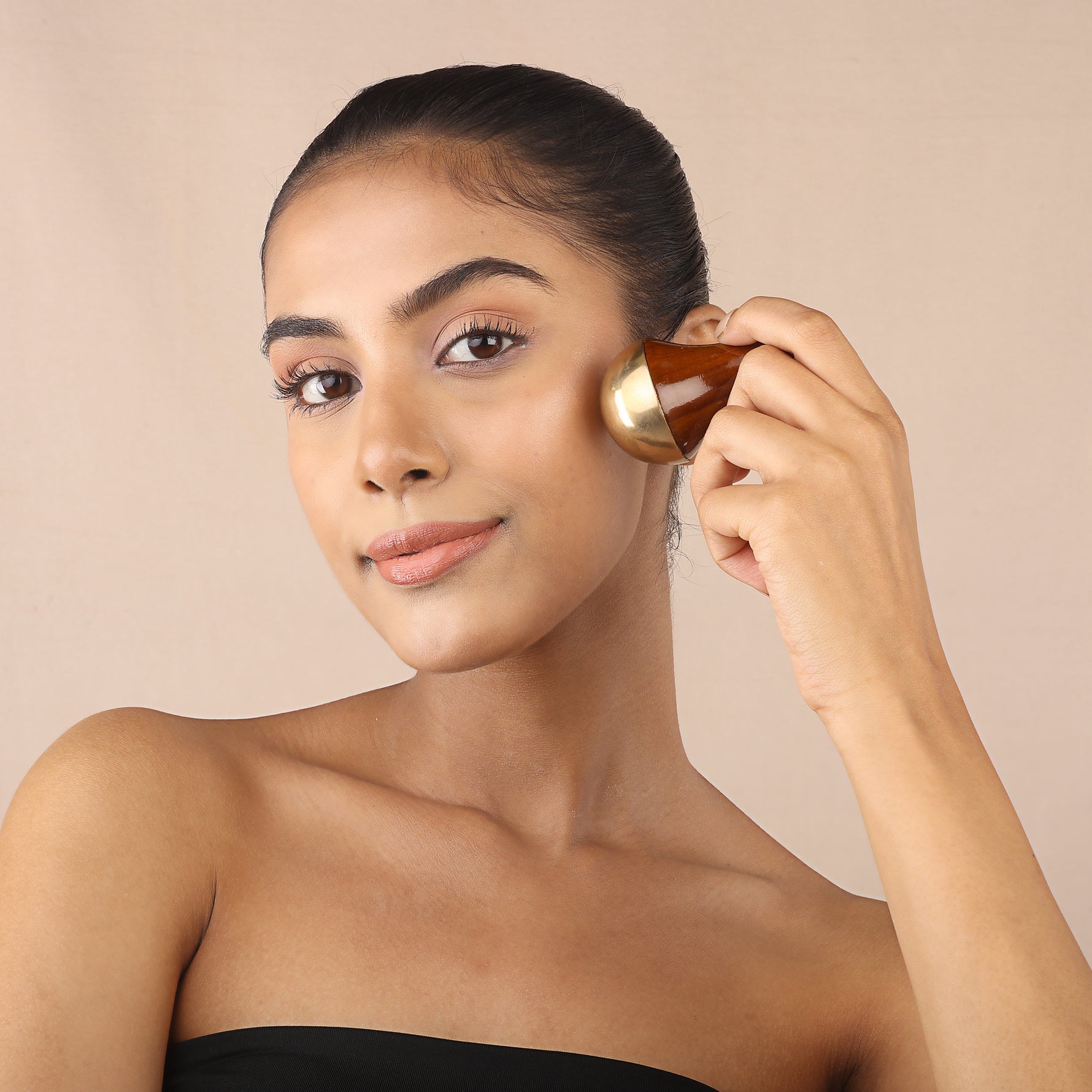
Unit price perTwo domes, each shaped for a different part of the face. The larger dome glides across cheeks, forehead and jawline, covering the broad, open areas in slow circular movements. The smaller dome turns for the precise work: temples, brow, under-eye, the edges of the nose.
The metal has a naturally cooling quality. In Ayurveda, this is traditionally associated with Pitta balance — a calming of warmth and reactivity in the skin. The faint grey-green tint you may notice during use is a natural reaction between the metal, the oil, and your skin's pH. It washes off easily and is not harmful.
Apply 3 to 4 drops of face oil before you begin. Work across both sides of the face, starting from the centre and moving outward. Gentle pressure is enough — the tool does the work. Five to ten minutes daily is ideal.
For external use only. Clean and dry thoroughly after each use. Store away from moisture.
UNLOCK 10% OFF
Kansa Wand - Double Sided
14.700 Ft
Unit price perTwo domes, each shaped for a different part of the face. The larger dome glides across cheeks, forehead and jawline, covering the broad, open areas in slow circular movements. The smaller dome turns for the precise work: temples, brow, under-eye, the edges of the nose.
The metal has a naturally cooling quality. In Ayurveda, this is traditionally associated with Pitta balance — a calming of warmth and reactivity in the skin. The faint grey-green tint you may notice during use is a natural reaction between the metal, the oil, and your skin's pH. It washes off easily and is not harmful.
Apply 3 to 4 drops of face oil before you begin. Work across both sides of the face, starting from the centre and moving outward. Gentle pressure is enough — the tool does the work. Five to ten minutes daily is ideal.
For external use only. Clean and dry thoroughly after each use. Store away from moisture.


What the Kansa Wand Ritual Does for Your Skin
- A consistent 5 to 10 minute daily practice becomes a moment of stillness. This is one of the reasons Mukha Abhyanga has been part of Ayurvedic Dinacharya (daily self-care) for thousands of years
- Skin appears visibly more settled and even after regular use — the cooling quality of Kansa is traditionally associated in Ayurveda with calming warmth and redness in the complexion
- Facial muscles release tension gradually with each session, leaving the face looking less held and more relaxed over time
- The two dome sizes allow a complete Mukha Abhyanga in one tool — the large dome for cheeks, forehead and jaw, the small dome for temples, brow and under-eye
- Used with a face oil, the wand makes every drop count — the slow circular movements encourage the oil to absorb more thoroughly than with fingertips alone

Your Mukha Abhyanga Ritual
Start with clean skin. Apply 3 to 4 drops of face oil and spread it across the face and neck with your fingertips — this is the medium the wand needs to glide without friction.
Pick up the wand by the handle with the large dome facing down. Starting at the chin, move upward and outward across the jaw toward the ear. Work up across the cheek in the same direction — from the nose outward, toward the hairline. Cross the forehead in long sweeping movements from centre to temple. Repeat each area 3 to 5 times per side.
Flip to the small dome for the detailed areas. Use light circular movements at the inner corner of the eye, along the brow bone, across the temple, and down the sides of the nose. These are the marma areas — energy points recognised in Ayurveda — where targeted attention has the most effect.
Finish with slow strokes down the neck. The whole practice takes 5 to 10 minutes. After use, wipe the dome clean with a soft, damp cloth and dry it fully before storing.
The Kansa Wand Needs Oil. These Are Our Recommendations.

Kumkumadi Serum
Our signature face oil. A classical Ayurvedic formula with Saffron, Sandalwood and Lotus, documented in the Ashtanga Hridayam. Lightweight, absorbs cleanly, and leaves the skin soft and luminous. The pairing most customers choose for their evening Kansa ritual.

Ayurvedic Face Oil
A Mukhalepa-style preparation with Panchavalkala, Triphala, Sandalwood and Vetiver in cold-pressed sesame oil. Cooling and grounding. Well suited to combination and Pitta-type skin, and a natural companion for the Kansa Wand's cooling bronze.

The Eight Marma Points of the Face
Marma points are specific junctions on the face where vital energy prana is said to gather. The Kansa wand is designed to work each one.
Sthapani — between the eyebrows
Avarta — along the brow ridge, above each eye
Apanga — outer corner of each eye
Shankha — the temples
Phana — on either side of the nostrils
Vidhura — behind the earlobe, at the jaw hinge
Shringataka — the centre of the face
Hanu — the chin and jaw
Use the large dome for Hanu, Vidhura and Shankha.
The small dome for Sthapani, Avarta, Apanga and Phana.
The design of this wand follows the map..
Made to Last. Care for It Accordingly.
The Kansa metal develops a natural patina over time, this is not damage, it is the character of a real bronze. To keep the surface in good condition, wipe clean with a soft damp cloth after every use and dry thoroughly. Avoid prolonged contact with water, oils left sitting on the surface, or abrasive materials. Store in a dry place away from humidity.